

The Poco X8 Pro dominates the mid-range gaming scene with its MediaTek Dimensity 8500-Ultra and a massive 6500mAh battery.
Samsung’s Galaxy A56 5G counters as a camera powerhouse, offering natural color processing, superior video stability, and a clean One UI 7 experience.
Choose the Poco for unmatched raw performance and endurance, or the Samsung for long-term software support and photography perfection.
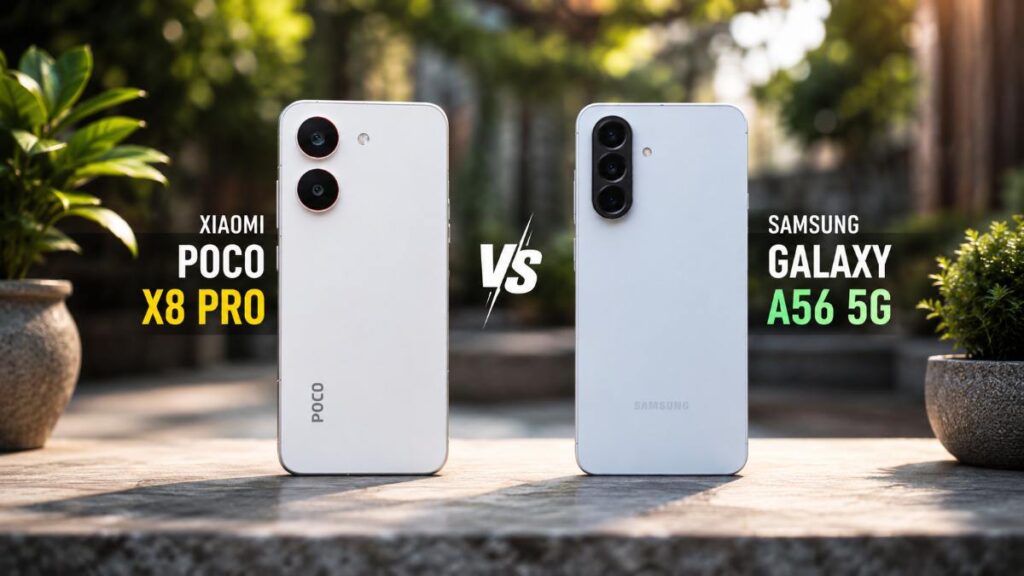
There is a lot of discussion about two phones in the mid-range segment in 2026 – Xiaomi Poco X8 Pro vs Samsung Galaxy A56 5G. One phone is much ahead in terms of power, gaming and battery, the other is strong in terms of camera, software support and long-term use.
Many call the Poco X8 Pro a “Gaming Powerhouse” because of its processor and large battery. And the Galaxy A56 5G is being called the “Best Camera” option because of its processing and versatile camera setup. But the real question is – which one is more suitable for you in real use?
Display: Which is more comfortable for gaming and media?
The Poco X8 Pro has a 6.59-inch 1.5K AMOLED display. Resolution 1268 x 2756, pixel density around 460 ppi. Supports 120Hz refresh rate, 3500 nits peak brightness and 3840Hz PWM dimming. The display has high resolution and brightness, which will improve outdoor visibility and multimedia experience. The smoothness of 120Hz is felt a lot more in gaming, especially in fast-moving games.
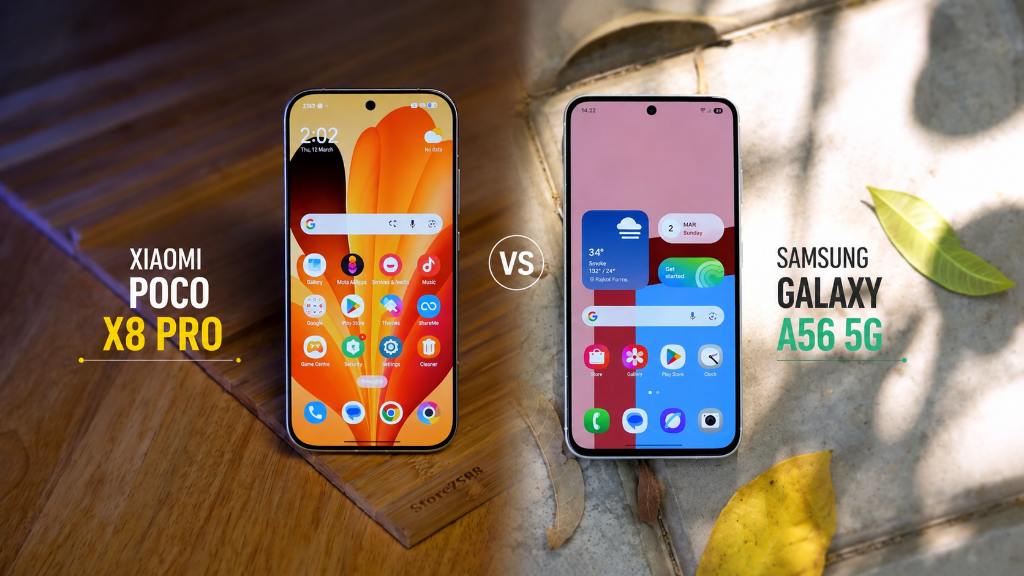
The Samsung Galaxy A56 5G has a 6.7-inch FHD+ Super AMOLED display. Resolution 1080 x 2340, brightness up to about 1900 nits. It has a 120Hz refresh rate but not as high brightness as the Poco. However, Samsung’s color tuning and contrast are much more natural. Samsung’s display feels more comfortable on the eyes while watching movies or editing photos.
In the real world: Poco X8 Pro is far ahead for gaming because of high resolution + high brightness + good PWM dimming. But for those who watch more movies and series or create content, Samsung’s natural colors and large screen will be preferable.
Performance and Gaming: Which is the real power?
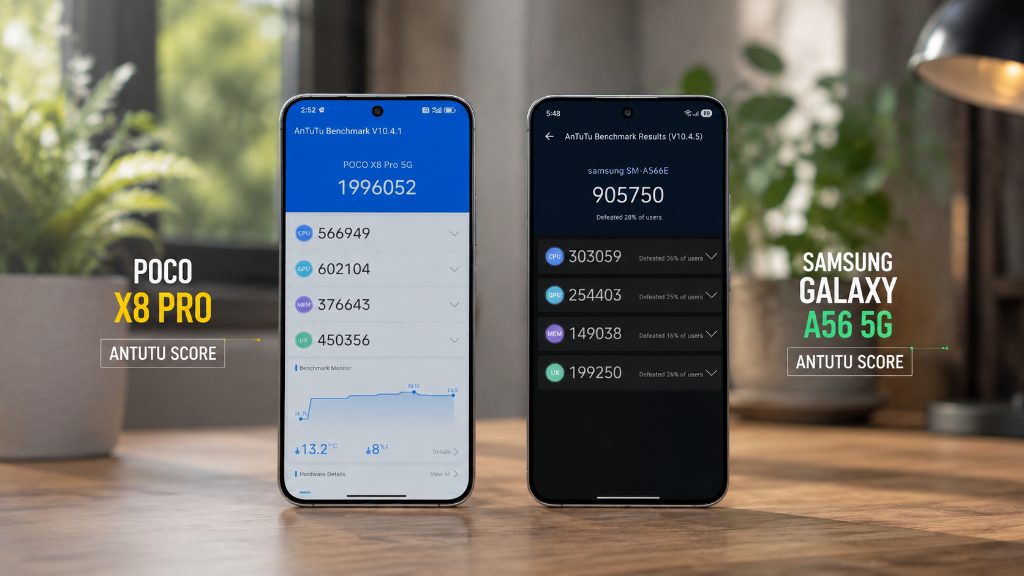
The Poco X8 Pro has a MediaTek Dimensity 8500 Ultra chipset. It scores around 2.0 to 2.2 million in the AnTuTu v11 benchmark. In Geekbench 6, the single-core is around 1590 and the multi-core is around 6109. This chipset is very powerful for gaming. It can maintain up to 90 FPS at high graphics settings in games like BGMI. Thermal management is also good – but the temperature many times fluctuating between 42-48 degrees during long sessions.
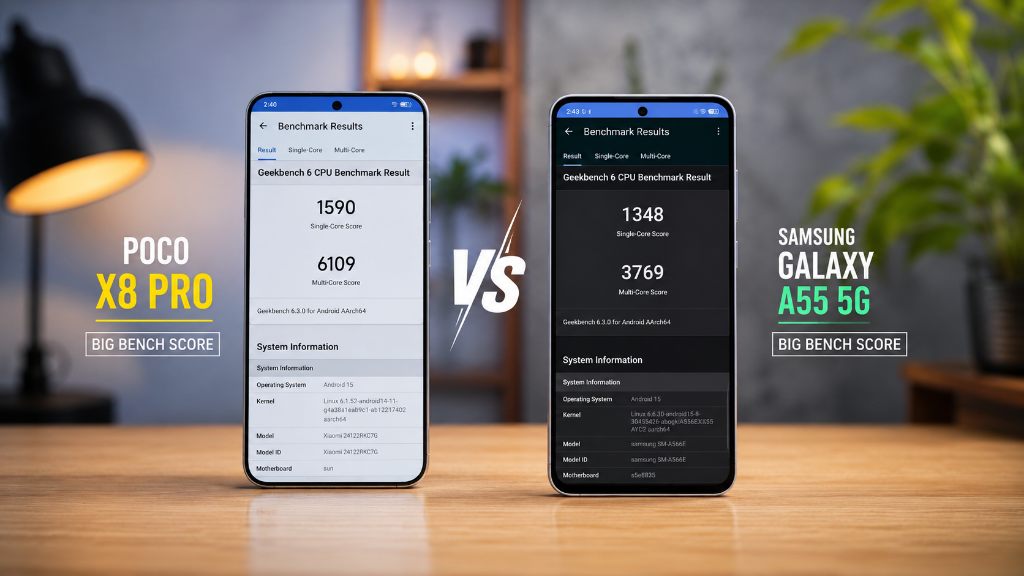
The Samsung Galaxy A56 5G has an Exynos 1580 chipset. The AnTuTu score is around 9.2 lakhs to 1 million. The multi-core score in Geekbench 6 is around 3800. This is sufficient for daily use and multitasking but is far behind the Poco in heavy gaming. It goes up to 60 FPS on BGMI at high settings, but throttling is high in long sessions and the temperature rises to 42-45 degrees.
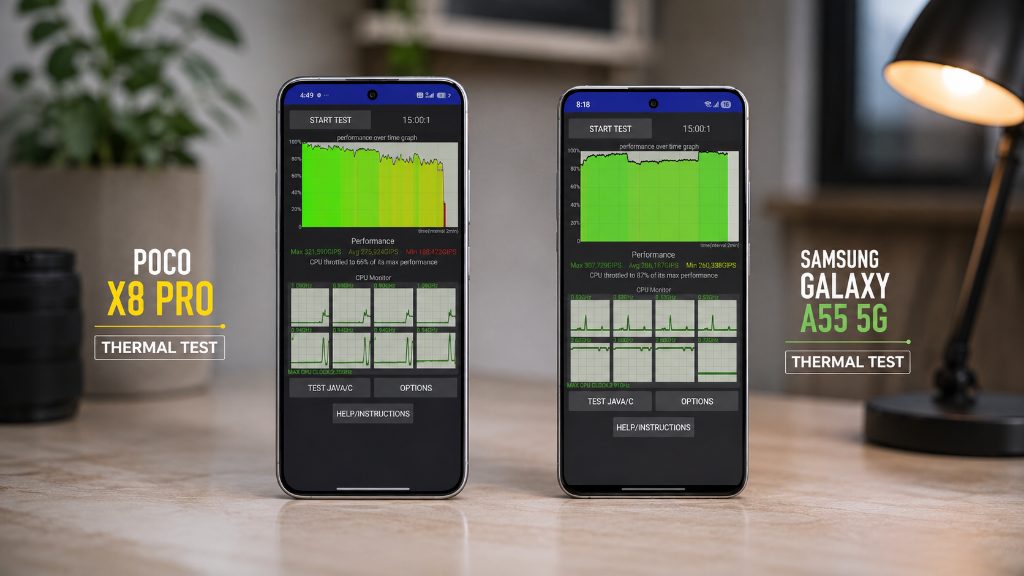
Reality of Gaming Test: When playing in BGMI Smooth + 120 FPS mode on Poco X8 Pro, the frame rate is very stable to 60-75 FPS. And on Galaxy A56 5G, the frame rate fluctuates between 45-60 FPS at the same settings, especially when many enemies come together. Poco is much ahead in thermal performance because its body and cooling system are better.
Camera: Details Comparison
You will get to see two rear cameras in total on Poco X8 Pro. Its main lens is equipped with a 50MP Sony IMX882 sensor (f/1.5 aperture) and OIS support. In addition, you will find an 8MP Ultrawide sensor as a secondary camera. A 20MP selfie shooter has been kept for the front.

The main sensor is good, it gives sharp and detailed images in daylight. But due to the low resolution of the ultrawide lens, details are less in landscapes or group shots. Noise is a little more visible in low light. Video 4K@60fps is supported but stabilization is mediocre. Even in some cases, it has been seen that its autofocus is better in video recording than Samsung.
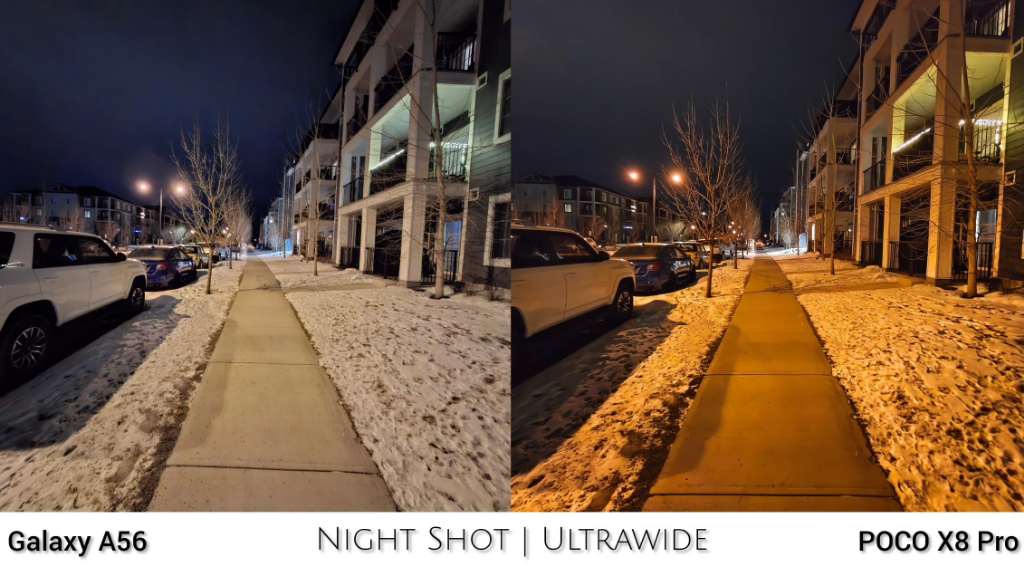
Now let’s talk about the Samsung Galaxy A56 5G camera. This phone comes with a 50MP Sony IMX906 sensor (f/1.8 aperture) with a sensor size of 1/1.56″ and OIS. There is a 12MP Sony IMX258 as an ultrawide camera (with f/2.2 aperture). There is also a 5MP macro sensor. A 12MP font shooter is provided for selfies.
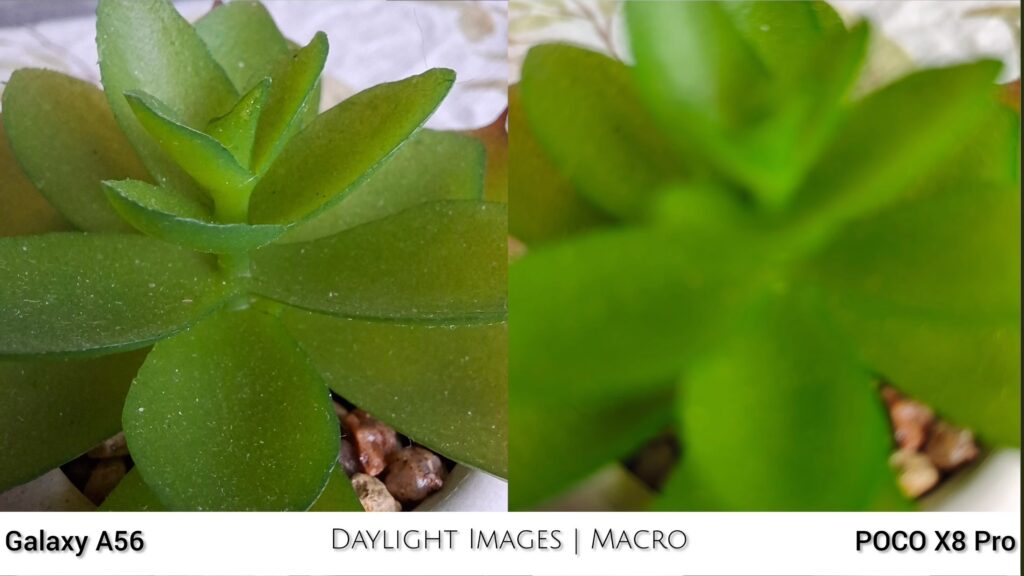
Samsung’s processing is much more mature. Colors are natural in daylight, skin tones are beautiful. The ultrawide lens is of good quality, so there is a lot of detail in landscape shots. Noise control is good in low light. Video stabilization (gyro-EIS) is very good – the video remains stable even with shaking hands. The macro lens makes it easy to take close-up shots.
Who will win in the camera?
If you just want to take good pictures with the main camera, the Poco is also enough. But if you want to take ultrawide, macro, video Want stability and natural colors – Samsung Galaxy A56 5G is far ahead. In real use, Samsung’s images look more “usable”.
Battery and Charging
Poco has a large 6500 mAh battery that you will find with 100W fast charging support. Real tests have shown that the phone is capable of providing a backup of 13 to 14 hours continuously in normal use.
Samsung Galaxy A56 5G has 5000 mAh + 45W charging. Although this battery capacity is normal for a normal user, it can provide a backup of 12 to 13 hours in continuous use. The charging speed is also much lower than the X8 Pro, so it takes much longer to charge compared to Poco.
Battery winner: Poco X8 Pro – clearly.
Software and long-term support
Poco X8 Pro comes with HyperOS 3 (Android 16). You will get 4 years of OS updates and 6 years of security updates. Samsung’s One UI is generally considered more mature and feature-rich, while HyperOS focuses on customization and ecosystem integration.
Samsung Galaxy A56 5G comes with One UI 7 (Android 15). The user interface is very clean and mature. The biggest advantage – 6 years of software updates and 7 years of security patches. This means that the phone will get new features even after 5-6 years.
Long-term user winner: Samsung – Undoubtedly.
Other features
In terms of connectivity, the Poco X8 Pro has Bluetooth 6.0 support, while Samsung has Bluetooth 5.3. Since Poco’s Bluetooth version is newer, it supports better audio codecs (such as LDAC, aptX). In terms of navigation, Poco’s GPS support is a little ahead — it has dual-frequency GPS + NavIC support, which gives a little better location accuracy in countries like India.
In terms of build quality and protection, the Poco X8 Pro has an IP68/IP69 rating, while the Samsung Galaxy A56 5G has an IP67 rating. In terms of dimensions, the Samsung is a little slimmer (7.4 mm) and lighter (197 grams), while the Poco body is 8.2 mm thick and weighs 204 grams. However, the Poco display to body ratio is a little higher (89%).
In terms of audio experience, both have stereo speakers. Since the Samsung supports Dolby Atmos, the sound feels a little more immersive while watching movies. The Poco speaker also delivers clear sound and the noise cancellation mic works well. In terms of sensors, the Samsung has additional Barometer and Geomagnetic sensors, which can provide a little extra benefit in certain applications (such as weather or compass apps). The Poco X8 Pro has an Infrared port, which is useful for controlling old TVs or ACs.
Overall, the Poco is slightly ahead in connectivity and protection, and the Samsung is slightly ahead in audio immersion and additional sensors.
Detailed comparison table
| Topic | Poco X8 Pro | Samsung Galaxy A56 5G | Winner |
|---|---|---|---|
| Display | 6.59″ 1.5K, 3500 nits | 6.7″ FHD+, ~1900 nits | Poco (Gaming) |
| Processor | Dimensity 8500 Ultra | Exynos 1580 | Poco |
| AnTuTu Score | ~2.0 million | ~1.1 million | Poco |
| Gaming Performance | 90 FPS Stable, Good Thermals | 60-75 FPS, High Throttling | Poco |
| Battery | 6500mAh + 100W | 5000mAh + 45W | Poco |
| Camera Versatility | Main Good, UW 약 | Main + UW + Macro, Good Processing | Samsung |
| Software Support | 4-5 Years | 6-7 Years | Samsung |
| IP Rating | IP68/IP69 | IP67 | Poco |
| Bluetooth | 6.0 | 5.3 | Poco |
Conclusion: Which one is for you?
If you want gaming, heavy performance, big battery and fast charging – then Poco X8 Pro is a good option for you. It will give you more power and endurance in the real world.
And if instead of performance you want camera, natural color, video stability and long-term software support – then take Samsung Galaxy A56 5G. Both phones are strong in their own place. Choose according to your use and price range.